I did
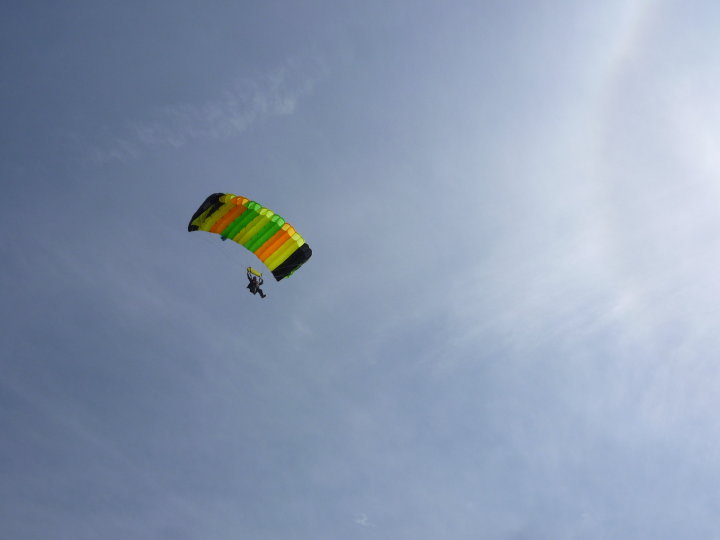
something yesterday I’ve never done before. Not once, but twice. I jumped
out of an airplane. I went skydiving, a birthday present from my son.

Sure, it was thrilling to climb out of a
Cessna 182 at 3,000 feet into an 80-mile-an-hour wind, hang from the
strut, look back at my divemaster, who smiled and pointed her finger at me
– and let go, trusting my life to a bag of nylon and a bunch of cords. The
serene beauty of the fields and forests surrounding Lake Wissota was
breathtaking. And swooping down to the drop zone, pulling down on my
toggles at 10 feet to flare the panels, and stepping gently onto the
blessed earth was as delicious as the first time I felt the intoxicating
balance of a bicycle.
All that was grand. But what made the
experience unforgettable was the six-hour training class, expertly taught
by a club member. Of course, the other newbies and I were apprehensive,
but we began to relax while I was hanging in the practice harness
demonstrating the various positions we were to assume if we were about to
hit a tree, building, car, cow, or string of power lines. The drill gave
us a lot of confidence.
That's when the instructor said, "Now,
if both your main chute and your reserve fail, you’ll gain a maximum
velocity of 163 feet per second, or 111 miles per hour, in 9 seconds. At
that speed you’ll hit the ground in 22 seconds, which rarely happens."
"I'm concerned," said one of my fellow
newbies. "Did you use a comma before your clause, 'which rarely happens'? I
never learned the rules for using commas."
It was an awkward moment. We all felt
sorry for the man who asked the question. Naturally, everyone looked at
me, perhaps because I was in the harness, or perhaps because they knew who
I was from seeing my photo in the newspaper police reports.
"Yes," I said, in my most reassuring
tone. "Use commas with which clauses that are parenthetical or
nonessential, as in ‘My reserve chute deployed perfectly, which was a good
thing, since I inadvertently cut and released my main.’ In that sentence,
the clause, ‘which was a good thing,’ is nonessential. It could be removed
without changing the meaning of the sentence."
"Thank you," said the man. "Such
a simple rule. I’m embarrassed I didn’t learn it in school. But how can I
tell if the clause is essential or nonessential?"
"Simple," I said. "If you can place the
clause in parentheses, use commas. If you can’t, don’t."
"Would you give us another example?"
asked another newbie, who like me was fit and trim.
"Sure," I said. "I used a comma before
the nonrestrictive who clause in my preceding sentence."
"That's right," said the instructor.
"Use commas with clauses that are nonessential; omit commas with clauses
that are essential."
"Exactly," I said, noting her
comma-free essential that clauses.
Exercise on using nonrestrictive
commas