When Ernest
Oberholtzer was 17, he suffered a severe bout of rheumatic fever that weakened
his heart. His doctors told him he wouldn’t survive the year. On June 6, 1977,
his damaged heart gave out and he died at the age of 93.
Ober was a man
of many passions. He studied the Ojibwe language at a time when our nation’s
policy was to suppress native culture and languages among Indian children. He
gathered Native American stories and legends. He photographed Indians and
wildlife, becoming famous for his photographs of moose. He played classical
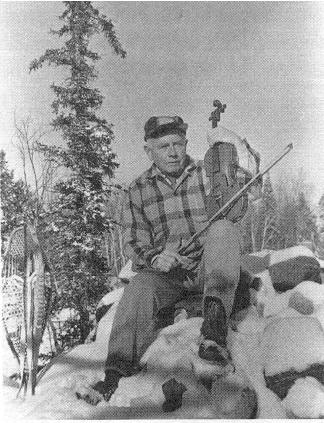
violin, collected books, and entertained friends by the dozen on his small
Rainy Lake island. Though he never married, women were drawn to him, and one
in particular fell deeply in love with him.
Perhaps
his greatest
passion was his love of wilderness. He
devoted a major portion of his life to
protecting the U.S.-Canadian boundary waters
region, a place of “unsurpassed beauty,” an area he considered “one of the
rarest of all regions of
the continent, if not the world.”
He knew the Minnesota-Ontario
lakes region well. In 1907, when he was 23, he went on the first of his many
canoe trips. Five years later, he paddled with Ojibwe trapper and guide Billy
Magee across the Canadian Barrens to Hudson Bay and back, completing the
two-thousand-mile, four-month exploration in freezing temperatures and blowing
snow just before the onset of the sub-Arctic winter.
A little man possessed of the
courage to defeat an industrial giant, he fought to protect the Rainy Lake
watershed from those who would plunder and transform it. He spearheaded the
1930 defeat of a plan to build seven dams to convert the boundary waters lakes
into a four great storage basins for the production of industrial
hydroelectric power.
For fifty years
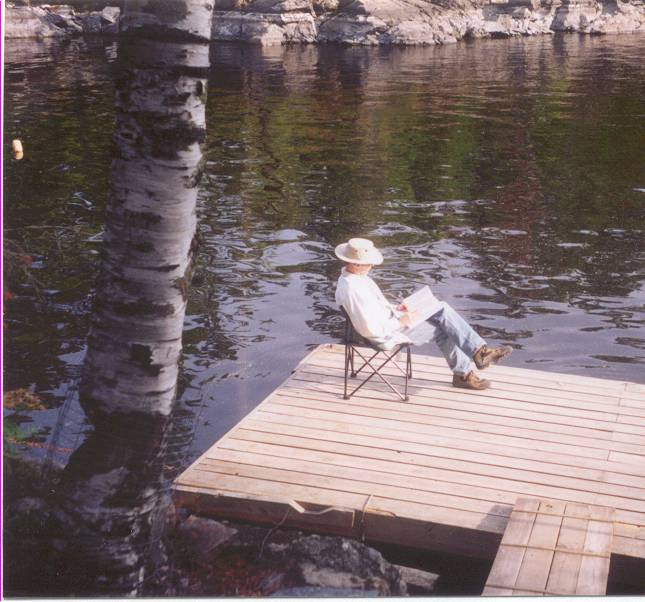
Ober made Mallard Island his home. Only eleven hundred feet in length
and without running water, the island contains seven buildings whose
construction was designed and supervised by Ober, two permanently grounded
boats, two pianos, and more than twelve thousand books, all carefully selected
and many mail-ordered by Ober. The buildings, some sided in cedar bark, rise
from their stone footings and blend harmoniously with the surrounding birch,
pine, and fir. One structure is a kitchen boat; another is reputed to have
been a floating whorehouse. On the east point, Front House looks to the
horizon across an open expanse of Rainy Lake’s some three hundred and thirty
square miles. On the west point, Japanese House, with its screened decks,
overlooks a bay cloistered by granite outcroppings and coniferous forest. To
the north and south, narrow channels separate Mallard from a cluster of
sheltering islands. Louise Erdrich describes the island as “the kind of
place that inspires a certain energy . . . a combination of erudition,
conservationism, nativism, and exuberant eccentricity.”
More than anything Ober wanted to
write. An avid reader and accomplished writer, he wrote dozens of articles,
thousands of letters to friends, and thousands more in support of his plan for
wilderness preservation, but he never achieved his lifelong ambition. He never
wrote a book about his canoe trips with Billy Magee, and he never wrote a book
about Native American legends – books that would justify his Harvard-educated
Northwoods existence, books whose royalties, he hoped, would solve his
lifelong financial problems. This failure haunted him as the great frustration
and disappointment of his life.
In his final years Ober
was robbed of his ability to speak by a series of minor strokes. But as reported
by Joe Paddock in
Keeper of the Wild: The Life of Ernest
Oberholtzer, he still had
good days. One day, the late Ted Hall, a former
correspondent and deputy New York bureau chief for Time-Life and publisher of
the Rainy Lake Chronicle, was pushing Ober in his wheelchair down a sidewalk
in International Falls. According to Hall, "The whole morning there
hadn’t been a word you could understand. He just communicated by signs. And as
we were crossing the street, an Indian woman called out to him and started a
conversation." Not until Ober’s friend had gone did Hall
realize that, in Ojibwe, Ober had been "completely, absolutely articulate."
After the conversation Ober once again "couldn’t get a word out."